Inside Broadway’s Lost Boys Frenzy: How A Cult Vampire Classic Quietly Became 2026’s Dark-Horse Fan-Hit
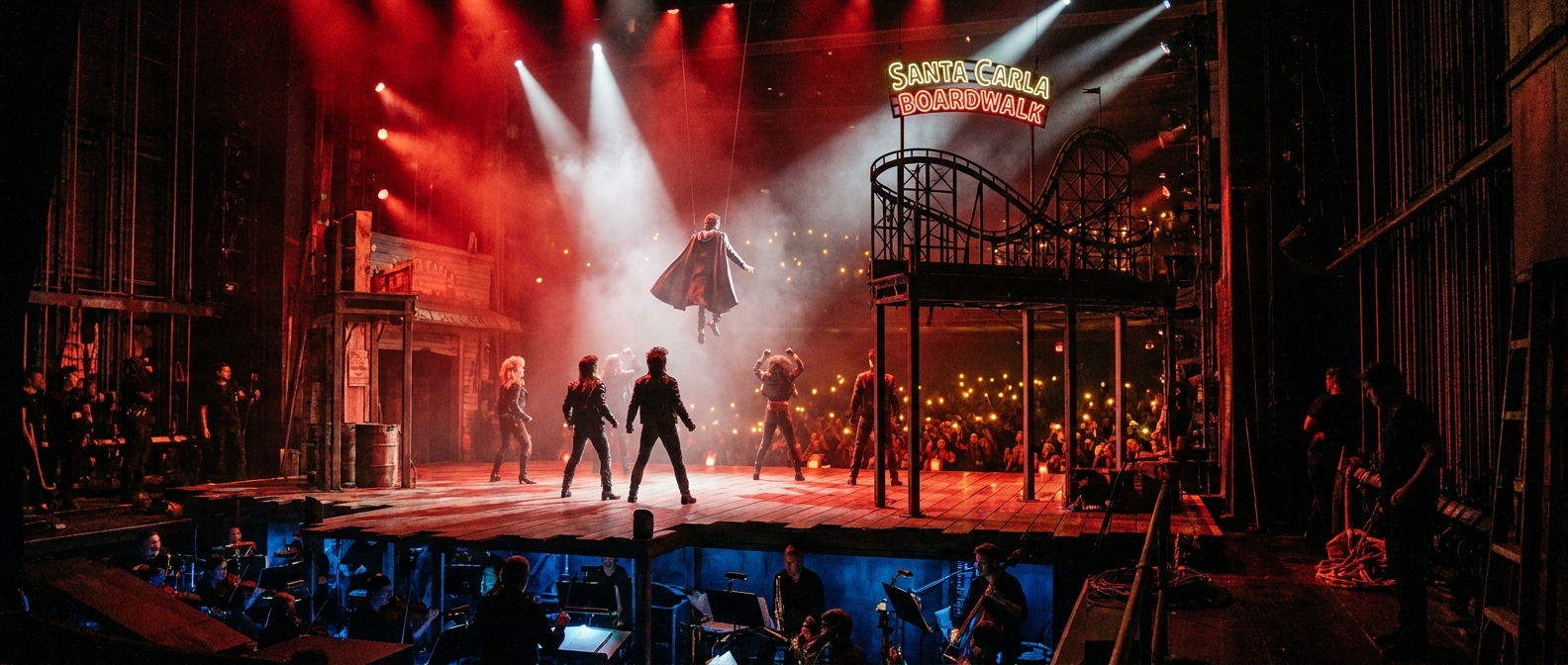
You are not imagining it. The Lost Boys is suddenly everywhere, and the coverage has been oddly useless. One camp is treating it like the second coming of cult theatre. The other is rolling its eyes at vampire nostalgia and calling it a gimmick. If you are trying to figure out what is actually happening inside the Palace Theatre, that back-and-forth gets old fast. The real story is more interesting. This show is not just riding on 1980s affection. It is testing whether Broadway can take horror language, fog, jump scares, predatory sound design, feral movement, and pulsing darkness, and still deliver the emotional release people expect from a big musical. That tension is why horror fans, old-school Broadway regulars, and nostalgia-heavy movie lovers are all arguing over the same production. Backstage, the team is not just putting on a vampire show. They are trying to solve a live theatrical engineering problem in real time.
⚡ In a Hurry? Key Takeaways
- The Lost Boys Broadway musical backstage story is about craft, not just hype. The production is carefully balancing horror effects with classic musical storytelling.
- If you want to understand why the show works or misfires, watch the lighting shifts, sound build, and scene pacing more than the plot changes.
- This matters beyond one season. It is a useful case study for fans and creators who want to see how risky genre adaptation actually functions in a Broadway house.
Why this show has become a fight online
The easiest way to talk about The Lost Boys is to reduce it to a vibe. Sexy vampires. 80s cool. Leather, fog, and blood. That is what most headlines do.
But inside the theatre, the show is stirring up debate for a more practical reason. It is caught between three audiences with very different expectations.
Horror fans want danger
They do not just want references to the movie. They want the room to feel unstable. They want darkness that hides things, music that rattles, and stage pictures that feel a little unsafe.
Nostalgia fans want recognition
They want the iconic lines, the boardwalk energy, the biker gang swagger, and enough visual callbacks to feel the original film is being honored.
Broadway regulars want shape
They want character arcs, song placement that makes dramatic sense, clean storytelling, and a payoff that feels earned rather than pasted on.
Most new musicals only have to win one or two of those groups. The Lost Boys is trying to satisfy all three. That is why reactions look so split. People are judging the same show with completely different scorecards.
What is actually happening backstage at the Palace Theatre
The best way to understand the current frenzy is to stop thinking about the production as a simple adaptation and start thinking about it as a systems test.
Backstage, every department is solving the same problem. How do you make horror read in a giant proscenium house without flattening it into camp or choking the musical life out of it?
Lighting is doing half the storytelling
In a horror movie, the camera tells you where to look. On stage, light has to do that job. In The Lost Boys, the lighting design appears to be carrying a huge amount of narrative weight.
When the show wants seduction, the palette warms just enough to pull you in. When it wants threat, shadows get harder, faces are carved more aggressively, and the stage space starts to feel deeper than it really is. That matters in a house as large as the Palace, where atmosphere can easily get washed out.
The clever bit is not just darkness. Anyone can dim the stage. The trick is selective visibility. The audience sees enough to stay oriented, but not enough to relax. That is much harder than it sounds.
Sound is being used like a horror camera lens
People tend to focus on songs when they talk about musicals, but the more revealing part of The Lost Boys Broadway musical backstage story is probably the sound work between songs.
Underscoring, low-frequency rumble, offstage texture, sudden dropouts, and directional effects help create the feeling that the danger is moving around the audience, not just standing center stage under a spotlight. In a vampire story, that matters.
It also explains why some viewers come out thrilled while others feel battered. Horror sound is physical. It gets into your chest. If you are expecting a smoother, more polished Broadway mix, this approach can feel abrasive. If you want menace, it is exactly the point.
Pacing is being tuned week to week
This is the part reviews often miss. Early in a run, a show like this is still learning where the audience breathes, laughs, tenses up, and checks out.
Horror-musical pacing is a balancing act. Move too fast, and the emotional beats do not land. Linger too long, and the danger loses its snap. The Lost Boys seems to be living right in that problem space, which is one reason fans are comparing experiences and noticing differences from one week to the next.
That is not a sign of failure. It is often a sign that a production is still actively shaping itself in front of an audience.
Why adapting a cult vampire movie is harder than it looks
Movies and musicals do not scare people in the same way.
Film can cut. It can zoom. It can hide a seam. Theatre cannot. On stage, transformation has to happen in shared space. The audience can see the trick and still be moved by it, but only if the trick has style and confidence.
The musical has to earn its songs
This is where many genre adaptations wobble. If characters burst into song at the wrong emotional temperature, the fear evaporates. A vampire threat that should feel primal suddenly feels decorative.
So the creative team has to answer a blunt question over and over. Why is this a song, and why now?
When the answer is rooted in desire, hunger, loneliness, family fracture, or seduction, the show tends to click. When the answer feels like “because we need a number here,” the spell breaks.
Camp is both a tool and a trap
The original Lost Boys has a playful, excessive streak. Ignore that, and the adaptation gets stiff. Push it too far, and you end up with parody.
The production’s most interesting backstage choice seems to be that it does not run from camp, but it also does not let camp run the room. It uses flashes of it to release tension, then pulls the audience back toward danger.
That rhythm is one reason people are arguing. Some see tonal control. Others see tonal whiplash. Both reactions make sense.
What fans are probably responding to, even if they do not phrase it that way
A lot of audience members are not leaving the theatre saying, “I admired the integration of horror grammar into a musical framework.” They are saying, “That felt wild,” or “I did not know whether I loved it,” or “I cannot stop thinking about the bike entrance.”
That is still useful information.
What they are responding to is friction. Broadway often smooths edges. The Lost Boys, at least in its current form, seems more interested in keeping some roughness alive. Not messy by accident. Rough by design.
The movement language matters
Vampires cannot move like standard musical-theatre cool kids or the illusion dies. The physical vocabulary needs to suggest hunger, pack instinct, suspended gravity, and an off-human grace.
That does not mean constant acrobatics. In fact, overdoing the movement can make the creatures less scary. Restraint is often stronger. A delayed head turn. A synchronized stillness. A sudden burst of speed. Those choices tend to land harder than nonstop stylization.
The ensemble is carrying atmosphere, not just filling space
In many musicals, the ensemble supports scale. Here, the ensemble also supports dread. They help define how porous the world feels. Is danger isolated to one scene, or is it in the air all evening?
That is a big backstage distinction. When ensemble performers are used as environmental pressure instead of background decoration, the whole room feels more alive.
Why the Palace Theatre changes the equation
Venue matters. A horror musical in a small downtown room can feel intimate and filthy in a good way. A horror musical in a large Broadway house has to work harder.
The Palace gives the production scale, but it also creates risk. Too much visual detail gets lost. Small fear beats can disappear. Subtle acting choices need support from design or they do not read in the back half of the house.
That is why the technical departments are so central to this conversation. They are not decorative layers. They are the bridge between concept and audience experience.
What is working, and where the strain still shows
No interesting experiment is smooth all the way through. The Lost Boys seems to be succeeding most when it trusts mood, image, and appetite. It seems less settled when it has to explain itself too neatly.
What is working
Atmosphere. Sensory control. A real attempt to make Broadway feel predatory for stretches. A willingness to let scenes breathe in darkness instead of over-lighting everything for safety.
There is also real value in the production refusing to sand down the story into generic crowd-pleasing uplift. That restraint gives the material some bite.
Where the strain shows
Exposition is the usual trouble spot in adaptations like this. The more the show has to stop and tell you lore, the more it risks stepping out of its own spell.
The other pressure point is emotional calibration. If the family core gets too thin, the vampires feel stylish but weightless. If the human drama gets too heavy, the show can lose velocity.
That balancing act is the backstage story in miniature.
Why this matters beyond one vampire musical
This is the part that gets lost when coverage stays stuck on grosses, stunt casting, or social media reaction clips.
The Lost Boys is useful because it is a live test of how Broadway might absorb more horror aesthetics without simply turning them into Halloween décor. That is a much bigger question than whether one show is a hit, a miss, or a cult curio.
For creators, the lesson is practical. Design cannot be an afterthought in genre adaptation. Sound cannot just support songs. Light cannot just make faces visible. Pacing cannot follow the default rhythm of a conventional musical if the piece is trying to generate dread.
For fans, the value is just as real. Once you know where the work is happening, you can watch with sharper eyes. You stop asking only, “Did I like it?” and start asking, “How are they building this feeling?”
What to watch for if you see it yourself
If you want your own backstage-informed view of The Lost Boys, watch these three things.
1. Notice when the audience goes quiet
Not applause. Not laughter. Quiet. That tells you where the show has genuine control.
2. Track transitions, not just big scenes
Any production can spend money on a flashy entrance. The hard part is moving from scene to scene without dropping tension. Watch how sound and lighting carry those handoffs.
3. Pay attention to who the show thinks is the main event
Is it the vampires? The brothers? The seduction? The nostalgia? A production reveals itself through emphasis. That is often more telling than the script itself.
At a Glance: Comparison
| Feature/Aspect | Details | Verdict |
|---|---|---|
| Horror Atmosphere | Built through selective lighting, low-end sound design, and controlled visual darkness rather than nonstop gore. | Strongest part of the show’s identity. |
| Musical Storytelling | Works best when songs rise from desire, fear, or family tension. Weakens when exposition takes over. | Promising, but still a balancing act. |
| Audience Appeal | Pulls in horror kids, 80s nostalgia fans, and Broadway traditionalists, though each group wants something different. | Explains both the buzz and the backlash. |
Conclusion
If you have been trying to make sense of the The Lost Boys Broadway musical backstage buzz, the short version is this. The show is not just being loved or hated. It is being argued over because it is attempting something difficult in plain sight. Today’s conversation around new musicals is stuck on box office charts and casting gossip, but The Lost Boys is quietly doing something more interesting. It is stress-testing how far Broadway can bend toward horror aesthetics without losing its core musical-theatre heart. A grounded, behind-the-scenes breakdown helps fans and emerging creators understand how lighting, sound, and pacing are being retooled to make a cult vampire story sing in a proscenium house, right now, while the show is still fresh enough that choices are evolving week to week. That kind of snapshot is exactly what the global Legend The Musical community needs. It offers practical insight into how a risky adaptation actually works in the room, so people can steal the smart ideas, avoid the misfires, and feel plugged into the live experiment instead of just reading yesterday’s reviews.