Inside ‘Six’ The Movie-Musical Frenzy: How A Queer, 80-Minute Tudor Mega-Hit Just Hijacked Broadway Fandom Overnight
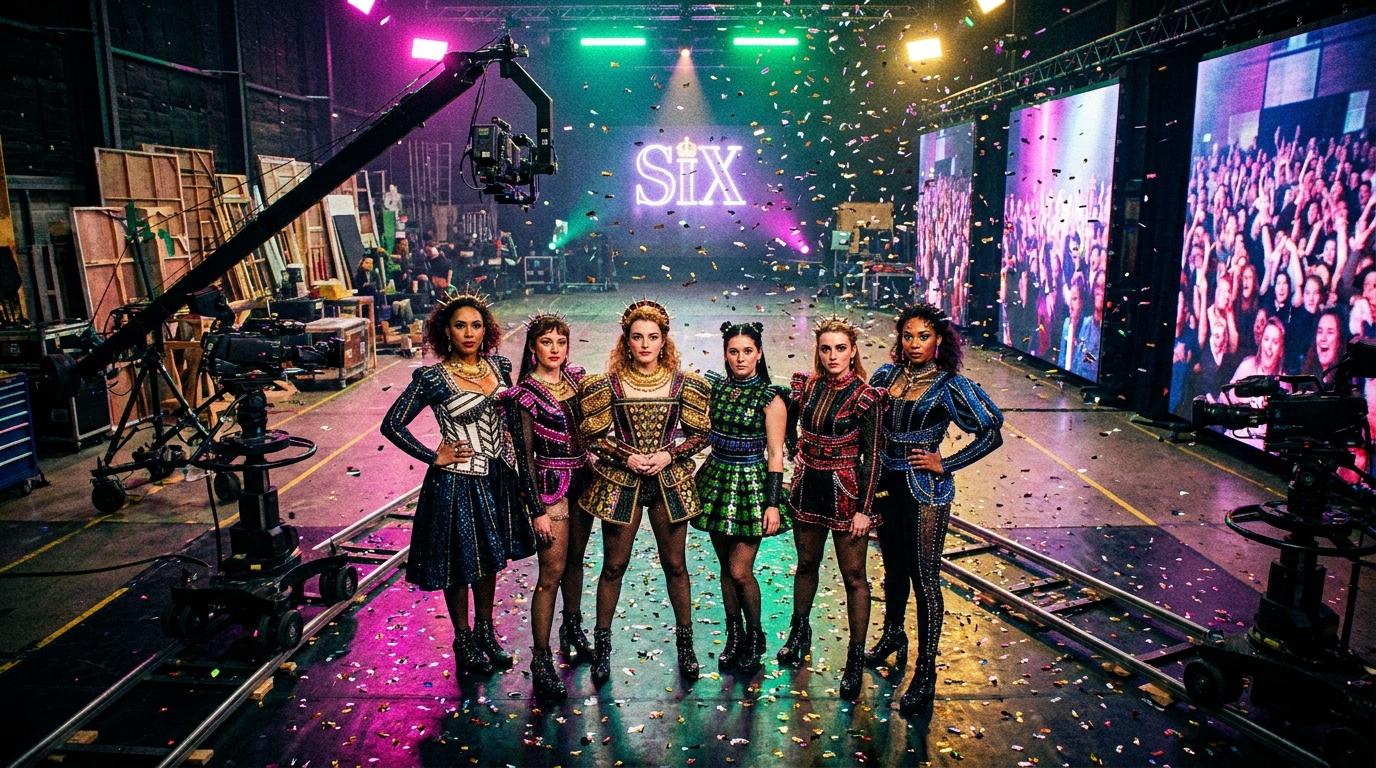
Your feed is not lying. The Six movie-musical moment is real, and if you feel slightly annoyed that everyone seems to have agreed overnight that Tudor pop queens are now the center of culture, that reaction makes sense. Hype moves fast. Musical discourse moves even faster. What makes this one worth paying attention to is not just fandom noise, but the way Six has turned a short, odd, proudly queer stage show into an event-cinema draw with genuine box office force and a clear effect on Broadway thinking.
That matters because Six movie musical box office and Broadway impact is not really one story. It is three stories at once. It is about a show built for repeat listens. It is about fans doing free marketing better than studios often do. And it is about producers seeing, in real time, that not every hit musical has to be a three-hour prestige brick. Sometimes 80 minutes, six microphones, and a fan base that treats cast changes like sports trades is enough to shift the market.
⚡ In a Hurry? Key Takeaways
- Six is not just having a viral week. Its movie release shows that lean, fan-driven musicals can punch far above their size at the box office and in Broadway influence.
- If you want to get ahead of the next wave, watch for short run times, soundtrack-first writing, strong fan identity, and shows that can travel well across TikTok, touring, and event cinema.
- The big value here is practical. Six offers a live case study in how queerness, formal weirdness, and commercial success can all sit in the same package.
Why Six suddenly feels bigger than a normal film release
The easy mistake is to treat the Six movie as just another filmed-stage event. It is more useful to see it as a stress test for the modern musical business.
Six began as a fringe-scale idea with a killer hook. Henry VIII’s wives, retold as pop divas in a concert competition. That pitch is compact, memeworthy, and easy to explain in one breath. In a crowded entertainment market, that matters more than people admit.
Then the show did something many larger musicals fail to do. It stayed simple. The score is stacked with hooks. The visual identity is instant. The characters are clear. The fandom can quote it, remix it, rank performances, and introduce friends without assigning homework first.
That simplicity is not “small” in a bad way. It is portable. Portable wins.
The box office lesson hiding in plain sight
Event cinema works best when fans already know the ritual
Lots of stage-to-screen releases hope audiences will show up because the title is famous. Six has a different advantage. Its audience already behaves like a fan community, not just a ticket-buying public.
That changes everything. Fans do not just attend. They organize. They post outfit photos. They compare queens across productions. They turn opening weekends into public events. For a movie release, that kind of built-in ritual can do more than a generic ad campaign.
So when people talk about the Six movie musical box office and Broadway impact, the key point is this: the box office is not only measuring mainstream interest. It is measuring how efficiently a fandom can convert excitement into transactions.
Short run time is a feature, not a compromise
This is one of the least glamorous but most important reasons Six travels so well. It is about 80 minutes. No filler. No “it gets good after intermission” warning. No need to clear half your day.
For theaters, cinemas, schools, tourists, and first-time musical viewers, that is a gift. More screenings can fit into a day. Casual viewers feel less risk. Fans are more likely to return. Parents can bring younger viewers without planning a military campaign.
Broadway used to treat long run times as a sign of seriousness. Six argues the opposite. Tight shows are easier to recommend, easier to tour, easier to film, and easier to turn into repeat business.
Why Broadway producers are absolutely paying attention
If you think producers are seeing only a fun one-off, think again. They are seeing a business model.
Six suggests that the next big stage hit does not need giant sets, endless lore, or old-fashioned respectability. It needs a strong concept, a distinct sound, and fans who feel ownership.
That has real consequences for what gets greenlit next. Over the next three years, expect more development energy around shows that are:
- under 100 minutes
- album-friendly from day one
- easy to brand visually
- castable with flexible, high-impact ensembles
- built to spark online fan behavior, not just reviews
That does not mean every new musical will try to copy Six directly. Most copycats will fail if they only steal the corsets-and-pop part. The deeper lesson is structure. Make it sharp. Make it legible. Make it fandom-ready.
What makes Six feel like a shift, not just a hit
It kept its queerness instead of sanding it down
One reason people are responding so intensely is that Six did not become huge by acting embarrassed about what it is. It stayed camp. It stayed stylized. It stayed emotionally direct in a very pop way. It let queer audiences recognize themselves in the sensibility, even though the text itself works broadly.
That is important because older commercial logic often assumed “weird” had to be toned down for scale. Six makes the opposite case. The weirdness is part of the engine.
It treats the cast like a feature, not a maintenance issue
In many long-running shows, cast turnover is treated like a problem to manage quietly. Six fandom turned it into content. New queens are events. Alternate lineups are worth discussing. Different productions feed the larger machine.
That makes the show feel alive across markets. It also builds a talent pipeline. Performers want in because the roles are visible, vocally demanding, and socially shareable. That affects casting culture well beyond one title.
What this means for stage-to-screen musicals
For years, stage-to-screen talk has bounced between two models. One is the expensive full movie adaptation. The other is the archival-feeling proshot that mainly serves existing fans.
Six points toward a more interesting middle lane. A filmed or cinema-ready version can be a social event, a fan checkpoint, and a recruitment tool for new audiences all at once.
That matters because not every musical should be stretched into a conventional film. Some shows lose energy when “opened up.” Six is almost anti-bloat by design. Its concert format is the point. Capturing that directly can be smarter than trying to turn it into a fake-naturalistic movie universe.
Studios and stage producers will notice. The question going forward will be less “Can this become a movie?” and more “What screen form preserves the thing people actually love?”
How to spot the next Six before everyone else does
Look for the soundtrack before the script summary
If people are listening on repeat before they ever buy a ticket, pay attention. A strong cast album is no longer just merch. It is market proof.
Six works because the songs circulate independently. They create attachment before attendance. That lowers the barrier to entry in every later format, including film.
Check whether fans can explain the show in one sentence
This sounds almost too simple, but it is useful. If the premise is clean enough to survive one text message, one TikTok caption, or one recommendation in a group chat, that is a strength.
“The six wives of Henry VIII as pop stars competing to tell their story” is instantly legible. A lot of worthy musicals are not.
Watch audience behavior, not just critic behavior
Reviews matter. Repeatable fan habits matter more. Are people collecting versions? Learning tracks? Following understudy announcements? Making ranking videos? Buying last-minute return tickets?
That is where future box office often shows up first.
Where the hype might be overstated
It is worth staying sane. Not every show can build a fandom this sticky. Not every offbeat musical is secretly the next global smash. And event-cinema spikes do not automatically translate into a permanent rewrite of the whole industry.
Also, Six has some advantages that are hard to clone. It is cheap to move relative to giant scenic musicals. It is short. It is youth-friendly. It is highly clip-able. And it arrived at the exact moment when online fan culture could supercharge all of those traits.
So no, the lesson is not “everything should be 80 minutes and neon.” The lesson is that efficiency, clarity, and fan intimacy are much more bankable than the old gatekeepers liked to admit.
What to say when someone asks if this is “just hype”
Here is the short answer. It is hype, but hype with receipts.
The receipts are the sustained fan ecosystem, the unusually portable format, the event-cinema appeal, and the way the show has shaped conversations about what a commercially viable musical can look like. The hype did not appear out of nowhere. It sits on a very sturdy piece of design.
If you want to sound smart before the thinkpiece cycle gets stale, focus less on whether Six is “good for Broadway” in some vague moral sense, and more on what it proves:
- a concise musical can feel major
- queer-coded style can be central, not decorative
- fandom can be a distribution engine
- a stage show does not need to become a conventional film to win on screen
At a Glance: Comparison
| Feature/Aspect | Details | Verdict |
|---|---|---|
| Run time and format | About 80 minutes, concert-driven structure, no dead zones, easy repeat viewing | A major competitive advantage |
| Fandom and marketing | Fans spread clips, cast news, rankings, outfits, and soundtrack love faster than standard ad campaigns | Core reason the film release hit as an event |
| Broadway impact | Signals demand for short, high-concept, musically dense shows with strong visual branding and queer-friendly appeal | Likely to shape development and casting choices for years |
Conclusion
Six matters because it gives us a clean, real-time example of how a small, offbeat musical can become a global force without ironing out the very things that made it special. That is the useful part for fans, performers, and anyone watching the business side. Its movie release is not just another pop culture spike. It is a field guide. Watch how the short running time, all-killer-no-filler score, and fandom-first marketing turned into event-cinema heat, and you can start spotting the next wave before everybody else starts pretending they saw it coming all along.